FHMS's Mary McDonald joins STEM acceleration program
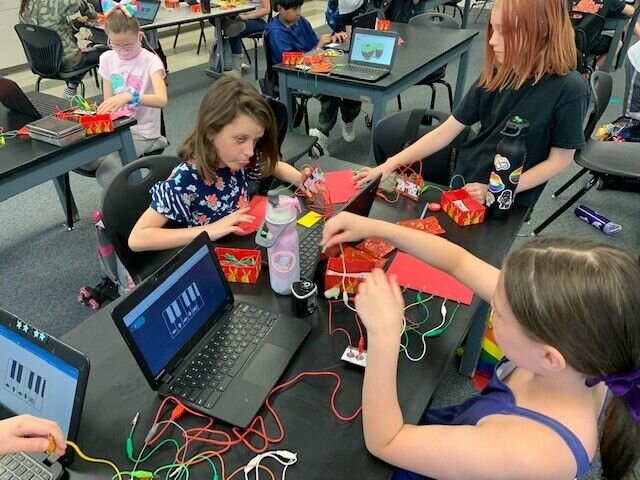
Mary McDonald's fourth grade class experiments with electricity currents last year. Photo courtesy of Mary McDonald.
Arizona STEM Acceleration Project (ASAP) is an initiative sponsored by Arizona State University and the Arizona Department of Education that will help deliver high-quality and hands-on science, technology, engineering, and math activities to Arizona students.
Fountain Hills Middle School’s own Mary McDonald was accepted into this new program, and she’ll receive $6000 to help her students and others around the state.
McDonald is one of 450 Arizona teachers that will receive $2000 worth of equipment and resources for her own classroom. Then, she and the rest of those teachers will take professional development classes provided by the program and write four lesson plans that will be complied on a free school resource website at the end of the year.
You must be a member to read this story.
Join our family of readers starting at $5 for your first month and support local, unbiased journalism.
Click here to see your options for becoming a subscriber.
Register to comment
Click here create a free account for posting comments.
Note that free accounts do not include access to premium content on this site.
I am anchor
FHMS's Mary McDonald joins STEM acceleration program
Mary McDonald's fourth grade class experiments with electricity currents last year. Photo courtesy of Mary McDonald.
Posted
Arizona STEM Acceleration Project (ASAP) is an initiative sponsored by Arizona State University and the Arizona Department of Education that will help deliver high-quality and hands-on science, technology, engineering, and math activities to Arizona students.
Fountain Hills Middle School’s own Mary McDonald was accepted into this new program, and she’ll receive $6000 to help her students and others around the state.
McDonald is one of 450 Arizona teachers that will receive $2000 worth of equipment and resources for her own classroom. Then, she and the rest of those teachers will take professional development classes provided by the program and write four lesson plans that will be complied on a free school resource website at the end of the year.
“I love doing things for my class,” McDonald said. “But I really think it’s for the good of the cause.”
McDonald will receive a $4000 stipend for completing the development courses and sharing her lesson plans. McDonald’s application asked her how long and how she teaches, among other questions related to her classroom techniques.
“It’s one thing to teach science, where you read a book and take a test on worksheets,” McDonald said. “It’s another thing to do it, and that’s really what they want to know, how do we do it.”
McDonald starts her fourth grade science class with the water cycle, and she builds on their knowledge from there. This year, her class made zip lock bags with drawings of the water cycle on it, and they taped the bags onto windows to see condensation in action.
“We do all kinds of things with water,” McDonald said. “We talk about water as the properties of matter, how water then affects weather, and we go from there. We talk about weather and how that affects the surface of the earth.”
Once the class finishes learning the water cycle, they learn about the rock cycle and plant cycles. Before the pandemic, McDonald was able to get Grand Canyon Park Rangers to come and show rocks to her classes that emphasized her point.
This year, McDonald’s class did a scavenger hunt on the middle school’s campus. They looked for depositions of sediment, exposed roots above the ground, channels from runoff and more.
McDonald likes to take her class outside of the classroom. Her efforts and funding from local organizations resulted in a school garden last year, and kids get to plant seeds and watch them grow throughout the year.
Currently, McDonald has tomatoes seeds sitting under grow lamps in the back of her classroom. McDonald is waiting for proper conditions outside before the students plant them, but they are also engaging in a cool experiment to see if space has any effect on growth.
One of the packages of tomato seeds was transported to the International Space Station by SpaceX CRS-21 Dragon, and those seeds spent six weeks in outer space from December 6, 2020, to Jan. 14, 2021.
“When you’re doing landforms, you bring in a big tin of dirt and then you have them be the glacier or pour the water and see what runoff looks like and how it can carve out a canyon,” McDonald said. “It makes a big difference to be able to actually experience it.”
McDonald finishes her annual lessons on energy, and renewable and nonrenewable resources. Her students will experiment with handheld generators, circuitry, solar panels and more. The lessons she teaches meshes well with sixth grade curriculum, and McDonald’s goal is to instill a love of learning so that her students continue to build on their knowledge.
“Everything we do here, it’s a building block for what you do there,” McDonald said. “I do that in hopes that they’re going to get excited about what they get to do next. If you like what you do here, you’re going to do even more there, and it’s going to go bigger or better or go deeper.”
McDonald will receive her $2000 worth of supplies in January 2023. Applications for the second year of ASAP opens in April and ends in July. Teachers can apply at stemteachers.asu.edu



Comments
No comments on this item Please log in to comment by clicking here