Voters may or may not have noticed on their ballot for the General Election this year there was no proposal for continuation of a one-half cent sales tax for regional transportation projects in Maricopa County.
In its last session the Arizona Legislature approved a referendum for continued Prop 400 funding, but that bill was vetoed by Governor Doug Ducey, with no apparent reason given.
Audra Koester-Thomas, Transportation planning Program for Maricopa Association of Government (MAG) made a presentation to the Town council on Nov. 1, to emphasize the need for continued funding for transportation. Koester-Thomas is a Fountain Hills resident and talked about what could be in store for local transportation improvements.
You must be a member to read this story.
Join our family of readers starting at $5 for your first month and support local, unbiased journalism.
Click here to see your options for becoming a subscriber.
Register to comment
Click here create a free account for posting comments.
Note that free accounts do not include access to premium content on this site.
I am anchor
Council hears transportation update
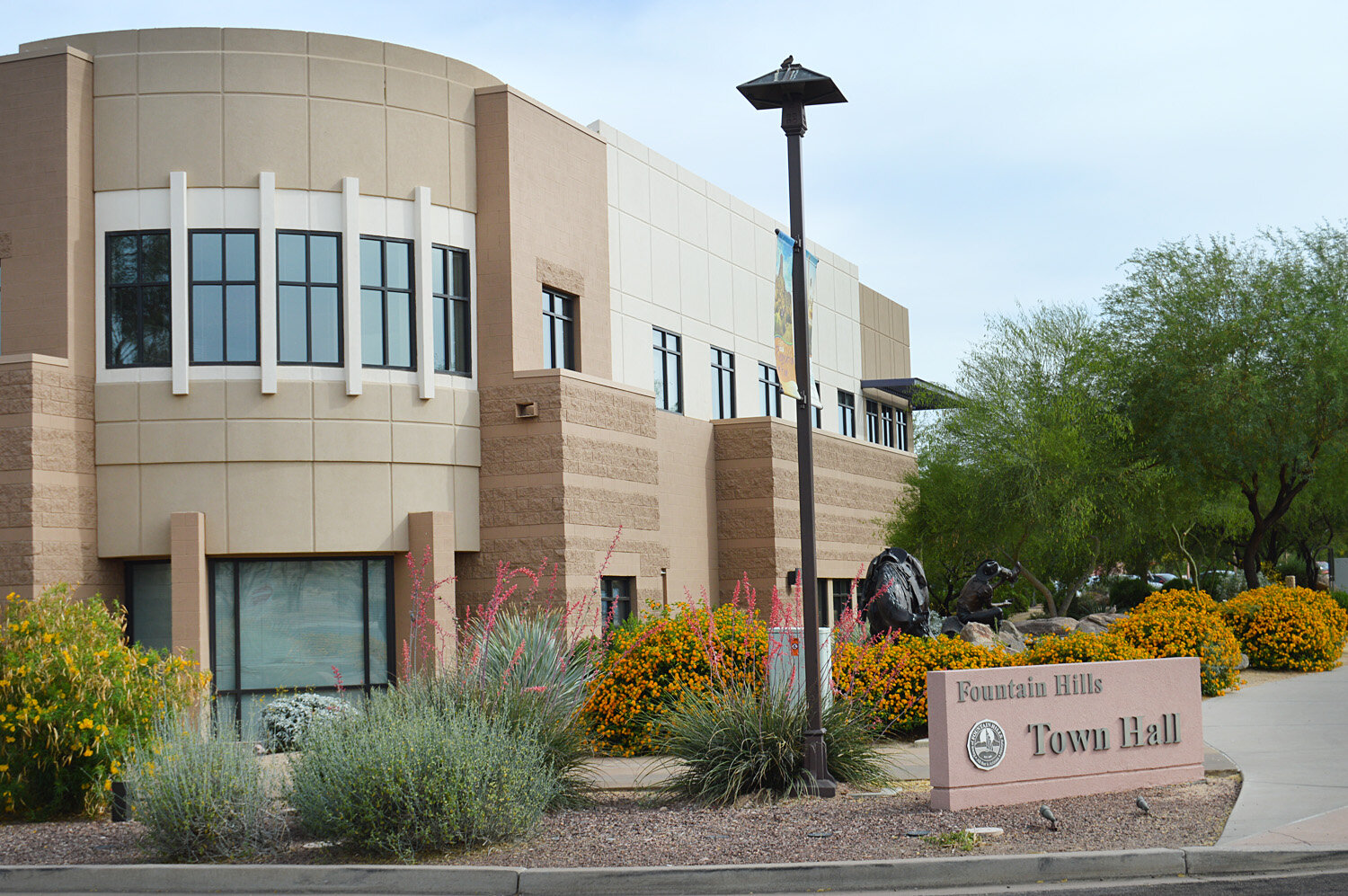
Town Hall
Posted
Bob Burns, Reporter
Voters may or may not have noticed on their ballot for the General Election this year there was no proposal for continuation of a one-half cent sales tax for regional transportation projects in Maricopa County.
In its last session the Arizona Legislature approved a referendum for continued Prop 400 funding, but that bill was vetoed by Governor Doug Ducey, with no apparent reason given.
Audra Koester-Thomas, Transportation planning Program for Maricopa Association of Government (MAG) made a presentation to the Town council on Nov. 1, to emphasize the need for continued funding for transportation. Koester-Thomas is a Fountain Hills resident and talked about what could be in store for local transportation improvements.
If the sales tax is continued for another 25 years, Fountain Hills is slated to receive potentially more than $60 million for regionally supported projects. Koester-Thomas said those include $17 million for Palisades Boulevard reconstruction, $6.6 million for Saguaro Boulevard reconstruction and $32.4 million for Shea Boulevard widening.
Also, without the funding extension Fountain Hills would stand to lose its only bus service from Valley Metro.
Proposition 400 was first approved in 2005 with an expiration date of 2025. It continued a funding mechanism first identified as Proposition 300 which funded transportation improvements between 1985 and 2005. Between 2006 and the 2025 expiration, Prop 400 funding has resulted in investments in 252 miles of new or improved highways/roads; $7.6 million in bus transit revenue; funding for ADA Paratransit for the disabled; widened and improved freeways and improvements in active transportation (bicycle/pedestrian), signal technology and air quality improvement.
There was also expansion to bus routing, light rail construction and streetcar routes.
Koester-Thomas outlined some of the key concerns related to the end of the revenue stream.
“The loss of the dedicated half-cent sales tax will be detrimental to the region’s transportation network,” she said. “Investments in the regional transportation network have led to the economic prosperity we see today.”
Maricopa County is one of the fastest growing regions in the country and the Greater Phoenix Economic Council (GPEC) highlights the transportation corridors in placement of new business and industry.
“Without continued investment, our region will lose its competitive edge,” Koester-Thomas said.
It would result in an increase in the cost of doing business, reductions in local business sales and reductions or elimination of high-quality jobs.
The transportation tax would lead to a $36.7 trillion investment in transportation projects regionally over the 25-year life of the tax.
Koester-Thomas said it is important to act as quickly as possible to get the program before voters. The revenue from the state Highway User Revenue Fund (HURF) continues to dwindle and that along with available federal funding would be insufficient to meet the future transportation needs.
If the legislature considers the extension again during its next session, along with a new governor in office, it is still unclear when the question would make it to the ballot. Presumably before the expiration of the current program in 2025.



Comments
No comments on this item Please log in to comment by clicking here