Arizona ranks near the bottom nationally in per-student education spending, while just over half of school districts’ operating budgets go directly toward classroom instruction.
The numbers highlight the financial challenges facing public schools as they try to meet students’ needs while covering the costs of running their campuses.
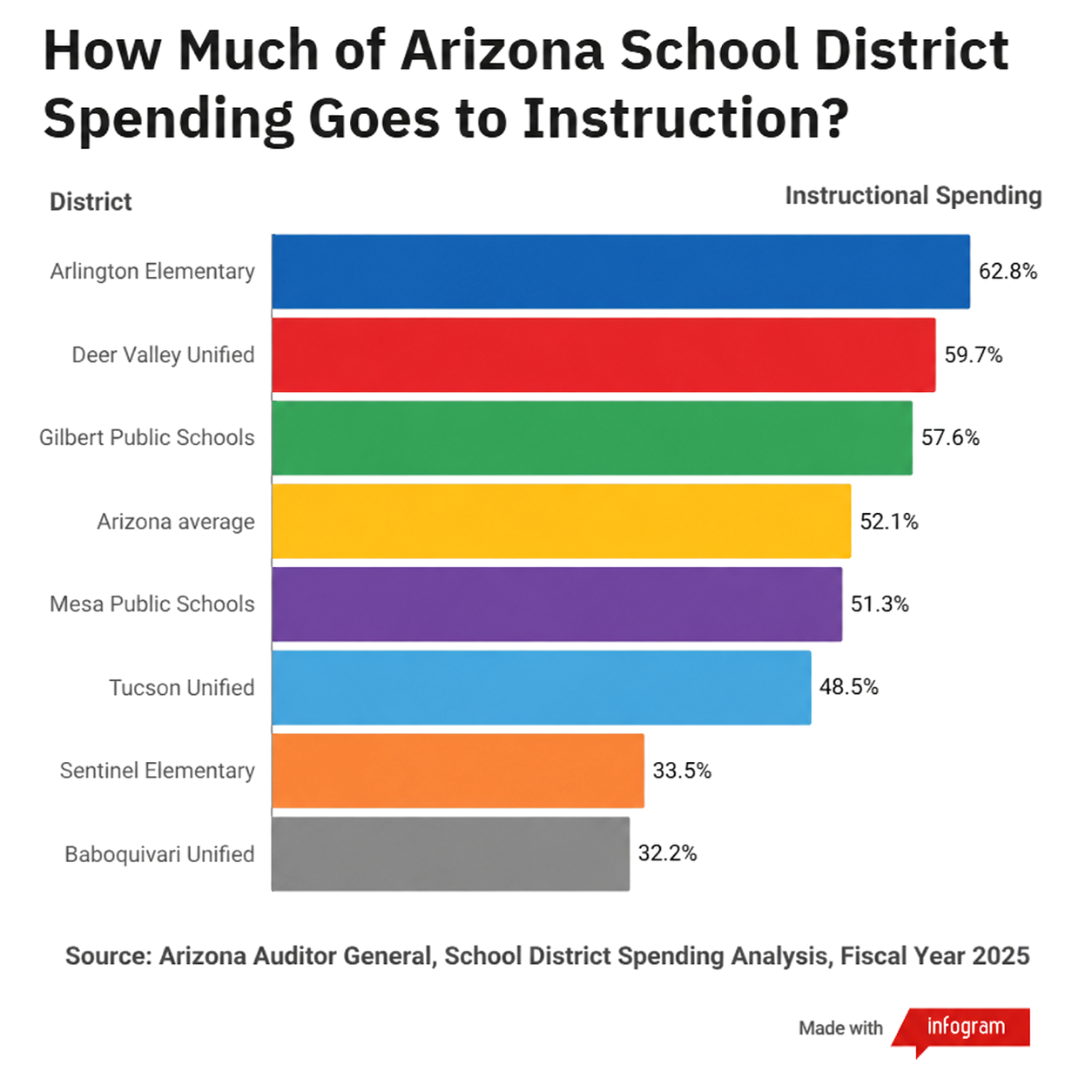
According to the Arizona Auditor General’s fiscal year 2025 School District Spending Analysis, 52.1% of statewide operational spending went toward instruction. At the same time, national comparisons continue to show Arizona spending less per student than most other states.
Together, the figures raise questions about whether Arizona schools have the resources they need and how districts divide the money available to them.
Arizona trails most states in school spending
Arizona spends an estimated $14,983 to $16,013 per student when funding from all sources is included, according to state budget documents and education spending reports. The exact figure depends on the fiscal year and which funding sources are counted.
A May 1, 2026 report by the Arizona Mirror, citing national education spending data, ranked Arizona 49th among the states. The National Education Association also publishes state-by-state comparisons that show how Arizona’s education spending stacks up against the national average.
The Arizona Joint Legislative Budget Committee’s All Funding for School Districts report provides another look at how public schools are funded by tracking money from multiple sources.
Still, total spending doesn’t tell the whole story. Education budgets include expenses such as school construction, federal grants and debt payments. Operational spending, by contrast, covers the day-to-day costs of keeping schools running.
That distinction matters. Money spent building a new school, for example, isn’t necessarily available to hire another teacher, buy textbooks or provide additional classroom support.
Where does the money go?
The Arizona Auditor General’s fiscal year 2025 analysis found that 52.1% of school districts’ operational spending went toward instruction. That category includes classroom teachers, educational materials, software and qualifying tuition expenses.
The rest goes toward the many other costs involved in educating students.
Schools must pay for electricity, air conditioning, building maintenance, security, transportation, cafeteria services, counseling, nursing, curriculum support and administration.
In Arizona, some of those expenses are particularly difficult to avoid. Schools need reliable air conditioning to keep classrooms safe and comfortable during the state’s long, hot summers. Districts must also maintain aging buildings, run bus routes and provide services for students with different educational needs.
Those costs aren’t necessarily signs of wasteful spending. They are part of operating a school system. But they leave districts with difficult decisions about how to balance basic operating expenses with the need for teachers, classroom materials and other instructional resources.
The statewide figure provides a useful snapshot of education spending, but it doesn’t tell us by itself whether districts are spending efficiently or whether students are receiving a quality education.
School districts have different spending priorities
The statewide average also masks significant differences among individual districts.
Data from the Arizona Auditor General show that Arlington Elementary directed 62.8% of its operational spending toward instruction. Deer Valley Unified allocated 59.7%, while Gilbert Public Schools spent 57.6% on instruction.
Mesa Public Schools, which serves approximately 55,600 students according to figures provided for this analysis, devoted 51.3% of its operational budget to instruction. Tucson Unified School District’s share was 48.5%.
The percentages were considerably lower in two smaller districts. Sentinel Elementary directed 33.5% of its operational spending toward instruction, while Baboquivari Unified recorded 32.2%.
Those numbers may stand out, but they don’t automatically mean one district is better at managing its money than another.
Smaller rural districts, for example, may have to maintain school buildings, operate long bus routes and pay administrative costs even when they serve relatively few students. Larger districts can spread some expenses across a bigger student population, but they may also face aging facilities, specialized program costs and enrollment changes.
The needs of the students themselves also affect district budgets. Special education services, counseling and other student support programs can require substantial resources outside traditional classroom instruction.
For that reason, spending percentages are most useful when considered alongside factors such as enrollment, geography, student demographics and the services each district provides.
Spending is only part of the picture
Arizona’s education spending figures point to two important questions: Is the state investing enough in its public schools, and are districts making the most of the resources they have?
National comparisons from the National Education Association and funding records from the Arizona Joint Legislative Budget Committee offer a starting point for examining the state’s investment. District-level budgets provide a closer look at how individual school systems use that money.
But increasing classroom spending isn’t simply a matter of shifting every available dollar toward instruction. Schools still need safe buildings, reliable transportation and support services for students. The challenge is meeting those obligations while ensuring that classrooms have the teachers, materials and resources students need.
Matt Loeschman has had two separate stints at Independent Newsmedia. He began as a reporter covering Peoria and later Surprise from 2000-2009. In 2017, he returned to Arizona and INI as the news editor of the Daily News-Sun (now the Phoenix Independent). He previously covered the Arizona Rattlers of the Indoor Football League for more than a decade.
Community: During high school football season since 2017, he contributes live postgame radio reports to the AIA Friday Night Football Wrap Up Show. He supports organizations such as Phoenix Children’s, Boys and Girls Clubs of the Valley and the American Cancer Society.
Education: The University of Texas at Austin majoring in Journalism-News and Public Affairs.
Random Fact: He can sing and he has been fortunate to meet many famous people during his journalism career including First Lady Hillary Clinton, King of Country Music George Strait and Oscar-winning actor Matthew McConaughey. Attended all 4 home games of the 2001 World Series.
Hobbies: Watching and playing a wide variety of sports, including golf, tennis, pickleball and softball. Playing PlayStation 5, working out, shopping and reading.


 By


Comments
No comments on this item Please log in to comment by clicking here